

- What customer actions you reward
- How points are stored and managed
- What customers can receive or redeem
Loyalty Hub
Loyalty hub is the module where you build and manage loyalty programs. Use Loyalty hub to:- Create loyalty programs
- Configure how customers earn points
- Define how points behave
- Connect point wallets, earning rules, rewards, tiers, and benefits
Loyalty program
A loyalty program is a configured loyalty setup. To run a points-based loyalty program, you need:- Point wallet
- Earning rules
- Rewards
- Tier structures
- Benefits
Loyalty member
A loyalty member is a Voucherify customer enrolled in a loyalty program. Loyalty membership is program-specific. The same customer can be a member of multiple loyalty programs.Designer
The Designer is where you configure and connect the building blocks of a loyalty program. You use the Designer to combine:- Earning rules
- Point wallets
- Tier structures
- Rewards
- Benefits
Program building blocks
The main building blocks define how customers earn, store, spend, and redeem points.Point wallet
A point wallet manages how points work on member loyalty cards. It controls how points are stored, activated, expired, earned, spent, refunded, and used for order payments or reward redemption. A loyalty program can include up to 10 point wallets, which lets you run different point balances or point currencies inside one program.Currently, point wallets support only an individual membership model.We plan to support different two additional membership models:
- Household wallets: Support private point pooling by several members.
- Team wallets: Support public group participation.
Pending points
Pending points
Pending points define when earned points become available to a loyalty member.Points can be available immediately, after a defined period, on fixed activation dates, or after a selected activation event.
Point expiration
Point expiration
Point expiration defines how long points remain valid.You can configure no expiration, expiration after a rolling period, expiration on specific calendar dates, or expiration after inactivity.
Earning limits
Earning limits
Earning limits control how many points a loyalty member can collect.You can define global limits for a period of time or per-transaction limits for a single transaction.
Spending limits
Spending limits
Spending limits control how many points a loyalty member can use.You can define global limits for a period of time or per-transaction limits for a single transaction.
Refunds
Refunds
Refunds define what happens to points when an order is refunded or canceled.Refund settings can remove points earned from a refunded transaction or return points spent on a refunded transaction. Partial refund handling by item or amount is not supported yet and is listed on the Loyalty v2 roadmap.
Pay with points
Pay with points
Pay with points lets loyalty members use points to pay for orders.When enabled, members can pay with points based on an exchange ratio formula.
Earning rule
An earning rule defines when customers receive points or another configured result for their actions. Each earning rule includes a trigger, optional conditions, and one or more effects. An earning rule can include multiple earnings applied sequentially — Voucherify applies the first matching earning configuration.Trigger
Trigger
A trigger defines when an earning rule runs:
- Order paid — triggers the earning rule after an order is successfully paid.
- Custom event — triggers the earning rule when a selected custom event is sent to Voucherify.
- Segment entered — triggers the earning rule when a member enters a selected segment.
Conditions: Tier
Conditions: Tier
The “Tier” condition defines that an earning rule applies when the member belongs to a specific loyalty tier.For example, the earning will trigger if the member belongs to the gold tier.
Conditions: When
Conditions: When
The “when” condition defines when an earning rule applies.For example, a rule can apply only when an order meets specific criteria.
Effects
Effects
Effects define what happens when an earning rule runs.For example, an effect can add points to a point wallet or issue a benefit.
Earnings
Earnings
Earnings define the conditions and effects for earning points.For example, an earning can grant fixed points, proportional points, or a benefit.
Trigger limits
Trigger limits
Earning frequency controls how often an earning rule can run through cooldown and frequency settings.You can configure the rule to run every time the trigger occurs or only within defined limits or time periods.
Tier structure
A tier structure groups loyalty members into levels within a point wallet. You can base tiers on criteria such as current point balance or total points earned. Tier structures can control qualification rules, expiration, grace periods, downgrade behavior, and tier-specific behavior. Currently, a loyalty program can include one tier structure. Tier mappings let you adjust selected program rules for members in a specific tier. Tier structures are optional.Tier
Tier
A tier is a level in a loyalty program, for example Bronze, Silver, or Gold.
Tier expiration
Tier expiration
Tier expiration defines how long a loyalty member keeps a tier.
Tier downgrade
Tier downgrade
Tier downgrade happens when a loyalty member no longer meets tier requirements.
Benefits
A benefit is value granted automatically when the defined conditions of an earning rule are met. For example, instead of earning points on a loyalty card, members can receive gift credits, discount coupons, or products. Members do not need to redeem benefits manually; they receive a benefit once they fulfill the earning rule conditions. Benefits are optional.Rewards
A reward is what loyalty members redeem using points. Reward types include digital rewards and material rewards. Digital rewards can issue discount coupons or gift cards, while material rewards represent physical products or SKUs. Rewards use spendings, which define when members can redeem the reward, which point wallet is used, and how many points the reward costs. One reward can be connected to multiple point wallets with different prices. Rewards are optional.How it works
A simplified loyalty flow looks like this: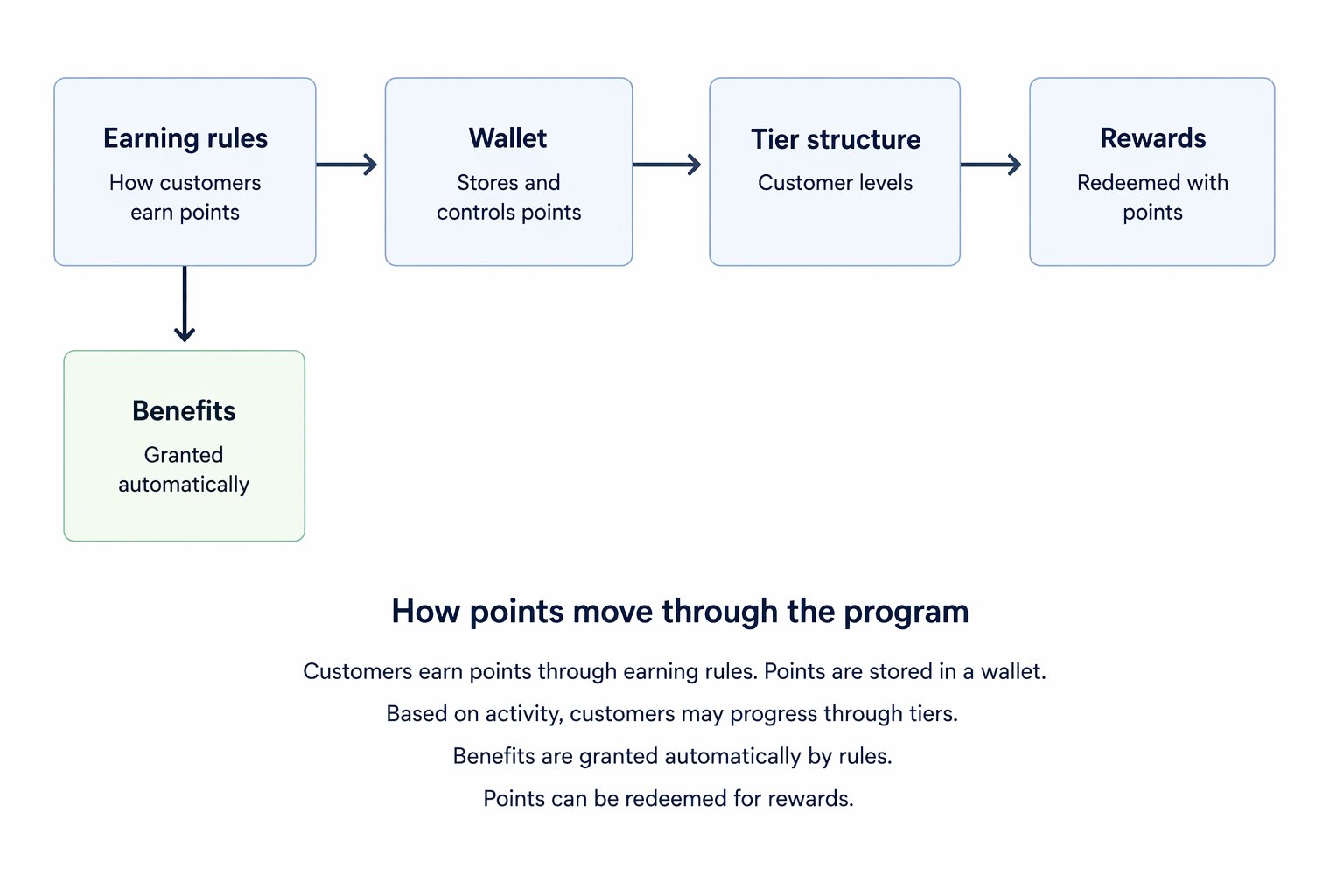
- A customer performs an action.
- An earning rule is triggered.
- Voucherify checks conditions and applies the first matching earning configuration.
- The earning rule applies effects, for example adding points or issuing benefits.
- Points are stored and managed in a point wallet, which governs pending points, expiration, limits, refunds, and spending.
- The loyalty member can qualify for tiers by earning points, use points to redeem rewards, or pay for orders with points.